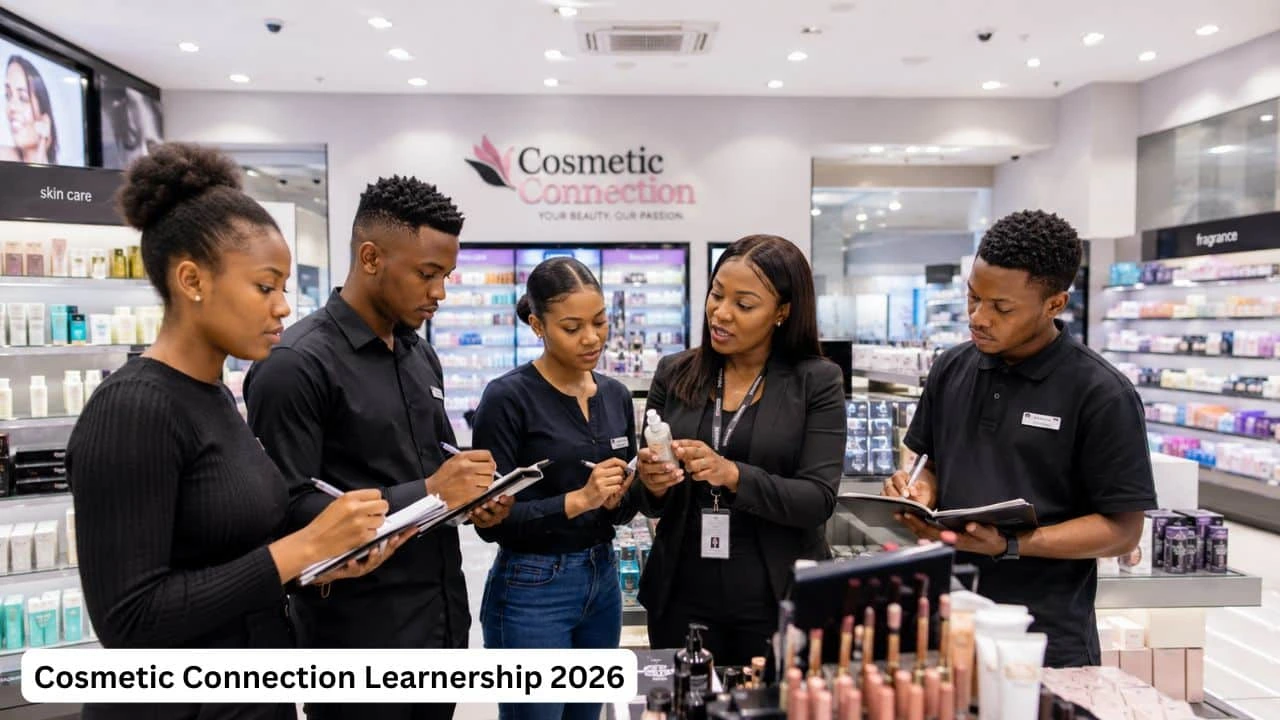
For many young South Africans, entering the formal job market in 2026 requires more than just a certificate; it requires proof of workplace competence. Cosmetic Connection, a well-known name in the South African retail beauty and personal care sector, has officially opened applications for its 2026 Wholesale & Retail Learnership Programme.
This 12-month initiative is specifically designed for unemployed individuals who are eager to build a career in the fast-paced world of retail. By combining structured classroom theory with hands-on store experience, the programme offers a pathway to a nationally recognized qualification and a monthly stipend of R3,500.
This guide provides an in-depth look at the programme structure, eligibility requirements, and the specific steps needed to submit a successful application before the May 16, 2026 deadline.
1. What is the Cosmetic Connection Learnership?
A learnership is a work-based learning programme that leads to an NQF-registered qualification. The Cosmetic Connection 2026 programme is governed by the Wholesale and Retail Sector Education and Training Authority (W&RSETA) standards.
Participants spend the year rotating through various departments within a Cosmetic Connection store. Unlike a traditional internship, which may be more observational, a learnership requires the student to complete specific “unit standards”—tasks that prove they can perform retail functions to a professional standard.
Core Programme Pillars:
- Duration: 12 Months of continuous training.
- Allowance: R3,500 per month to assist with transport and basic needs.
- Qualification: Wholesale & Retail Operations Certificate (NQF Level 2).
- Location: Primarily store-based (candidates must live near a branch).
2. Why Retail Training is a Strategic Career Move in 2026
Retail remains the backbone of the South African economy. In 2026, the industry has evolved to include more sophisticated inventory systems and digital customer service tools. Gaining experience now provides a “future-proof” skill set.
The Benefits of NQF Level 2 Certification
An NQF Level 2 qualification is an essential building block. It proves to future employers that you understand:
- The Supply Chain: How products move from a warehouse to a shelf.
- Legislative Compliance: Understanding consumer rights and safety protocols.
- Business Literacy: How a store manages its “bottom line” through sales and stock control.
3. Detailed Eligibility Requirements
To maintain a high standard of training, Cosmetic Connection has set specific criteria for the 2026 intake.
Mandatory Criteria:
- Employment Status: You must be currently unemployed.
- Education: A minimum of a Grade 12 (Matric) is typically preferred, though specific NQF level equivalents may be considered.
- Proximity: You must live within a reasonable distance of a Cosmetic Connection store. The company emphasizes this because the R3,500 allowance is intended for basic support, and high transport costs can make the programme unsustainable for the learner.
- Citizenship: Valid South African ID is required.
Personal Attributes:
- Passion for Beauty/Retail: Interest in the personal care industry is a plus.
- Reliability: Retail operates on strict schedules; punctuality is non-negotiable.
- Communication: A friendly, professional demeanor is essential for customer-facing roles.
4. Skills You Will Master During the 12 Months
The learnership is designed to be a “boot camp” for professional retail skills. Participants will be assessed on the following:
Customer Excellence and Sales
Retail is about people. You will learn how to approach customers, handle inquiries about beauty products, and manage difficult situations with professionalism. This includes “upselling” techniques and understanding product features and benefits.
Inventory and Merchandising
A store’s success depends on how its products are displayed. You will gain hands-on experience in:
- Stock Receiving: Checking deliveries against invoices.
- Merchandising: Learning “Planograms” (how to pack shelves to attract buyers).
- Stock Counts: Participating in monthly or quarterly inventory audits.
Point of Sale (POS) and Administration
Understanding the “till” is a fundamental skill. You will learn about various payment methods, handling cash securely, and processing returns or exchanges according to company policy.
ALSO APPLY FOR Absa Home Loans Learnership 2026: A Comprehensive Guide for South African Graduates
ALSO APPLY FOR SAB Technical Trainee Packaging Production Programme 2026: Requirements, Skills and Career Growth Opportunities
USEFUL LINKS
5. The Two-Step Application Process
Cosmetic Connection uses a digital-first recruitment approach for the 2026 cycle. It is important to follow both steps to ensure your application is captured.
Step 1: The Online Assessment
Candidates must first complete an online assessment. This is often a “situational judgment test” that asks how you would handle specific workplace scenarios.
- Tip: Find a quiet place with a stable internet connection before starting.
- Tip: Be honest and consistent in your answers.
Step 2: The TestGorilla Upload
Once the assessment is complete, you will be directed to the TestGorilla platform. This is where you will upload your supporting documents.
- Certified ID Copy: Must not be older than 3-6 months.
- Certified Qualification: Your Matric certificate or highest grade passed.
- Professional CV: A clear, one-to-two-page document.
6. How to Optimize Your CV for Retail
Even with no prior experience, your CV can stand out. Recruiters look for “soft skills” that translate well to a store environment.
Include these sections:
- Personal Statement: A short paragraph about your interest in the retail beauty industry.
- Key Skills: List things like “Fluent in [Languages],” “Punctual,” “Good with numbers,” or “Excellent communication.”
- Volunteer Work: Any experience at church, community centers, or school projects shows initiative.
7. Understanding the R3,500 Allowance
It is important to manage expectations regarding the financial aspect of the learnership. The R3,500 monthly allowance is not a full salary; it is a stipend provided to help you get through the year of training.
What the allowance usually covers:
- Daily transport to and from the store.
- Workday meals.
- Basic personal maintenance.
Many learners find that by the end of the 12 months, the “wealth” they have gained in the form of a qualification and an NQF Level 2 certificate is worth far more than the monthly stipend, as it opens doors to permanent roles with higher pay.
8. Why Early Application is Vital
The deadline is May 16, 2026. However, retail learnerships are highly popular and often receive thousands of applications within the first few days.
so interested candidates should complete the online assessment and upload their CV as soon as possible through the official online assessment portal.
The Risks of Applying Late:
- Technical Glitches: High traffic on the final day can crash application portals.
- Screening Fatigue: Recruiters often begin screening and shortlisting as soon as applications start coming in.
- Document Errors: If you apply early and make a mistake, you might have time to contact hr@cosweb.co.za to rectify it. If you apply on the last day, errors usually mean disqualification.
9. Frequently Asked Questions (FAQs)
1. Can I apply if I don’t have a Matric?
While a Matric (Grade 12) is the standard requirement for NQF Level 2 programmes, some exceptions are made based on RPL (Recognition of Prior Learning) or Grade 11 results. It is best to apply and provide your highest available qualification.
2. Will I be hired permanently after 12 months?
Permanent employment is not guaranteed. However, Cosmetic Connection uses the learnership to find “rising stars.” If you prove to be a valuable asset to your store during the year, you are in a prime position for any permanent vacancies that arise.
3. Do I have to pay to apply?
No. Legitimate learnerships will never ask you for an “application fee” or “placement fee.” If someone asks you for money, it is a scam.
4. What should I wear if I am called for an interview?
Dress “Smart-Casual.” For a beauty and cosmetic retailer, looking neat and well-groomed is very important as it reflects the brand’s image.
5. I live in a different province; can I still apply?
You can apply, but you must have a plan for accommodation and transport. Cosmetic Connection will not provide relocation costs. Most successful candidates are those who already live within a 15–20km radius of a store.
6. What is W&RSETA?
W&RSETA is the Wholesale and Retail Sector Education and Training Authority. They oversee the quality of the training to ensure that your NQF Level 2 certificate is valid and recognized by other companies like Shoprite, Pick n Pay, or Dis-Chem.
Final Thoughts: Your Gateway to the Retail Sector
The Cosmetic Connection Learnership 2026 is a significant opportunity for unemployed youth to trade 12 months of hard work for a lifetime of skills. Retail is a demanding environment that requires “thick skin,” a smile, and a high level of energy, but it offers a career ladder that can lead to store management, buying, or even corporate retail roles.
Prepare your documents, clear your schedule for the online assessment, and ensure your application is submitted well before May 16, 2026.
Contact for Enquiries: For any technical issues with the application portal, you can reach out via email to: hr@cosweb.co.za. (Note: Do not send your CV to this email unless specifically instructed; use the official application link first).

Ncebakazi Xatula is an Opportunities Researcher and Writer at Setasite, where she focuses on South African learnerships, skills programmes, bursaries, and youth employment pathways. Her work is dedicated to helping matriculants, students, and job seekers clearly understand how the country’s skills development system works and how to apply successfully for verified opportunities.
She specializes in breaking down complex SETA processes into practical, step-by-step guidance that first-time applicants can follow with confidence. Her research involves reviewing publicly available information from Sector Education and Training Authorities (SETAs), accredited training providers, employers, and official institutional sources to ensure content remains accurate and locally relevant.
Ncebakazi’s areas of focus include learnership requirements, application preparation, skills programme opportunities, and common mistakes that prevent applicants from being shortlisted. She is particularly passionate about improving access to reliable opportunity information for young people entering the South African job market.
At Setasite, her editorial approach prioritizes clarity, responsible reporting, and people-first usefulness to support readers making informed career decisions.